Cost per merged change should count only surviving changes
Cost per merged change is the AI ROI number to bring your CFO: the whole bill over changes that survived, paired with stability, at 20 to 150 engineers.

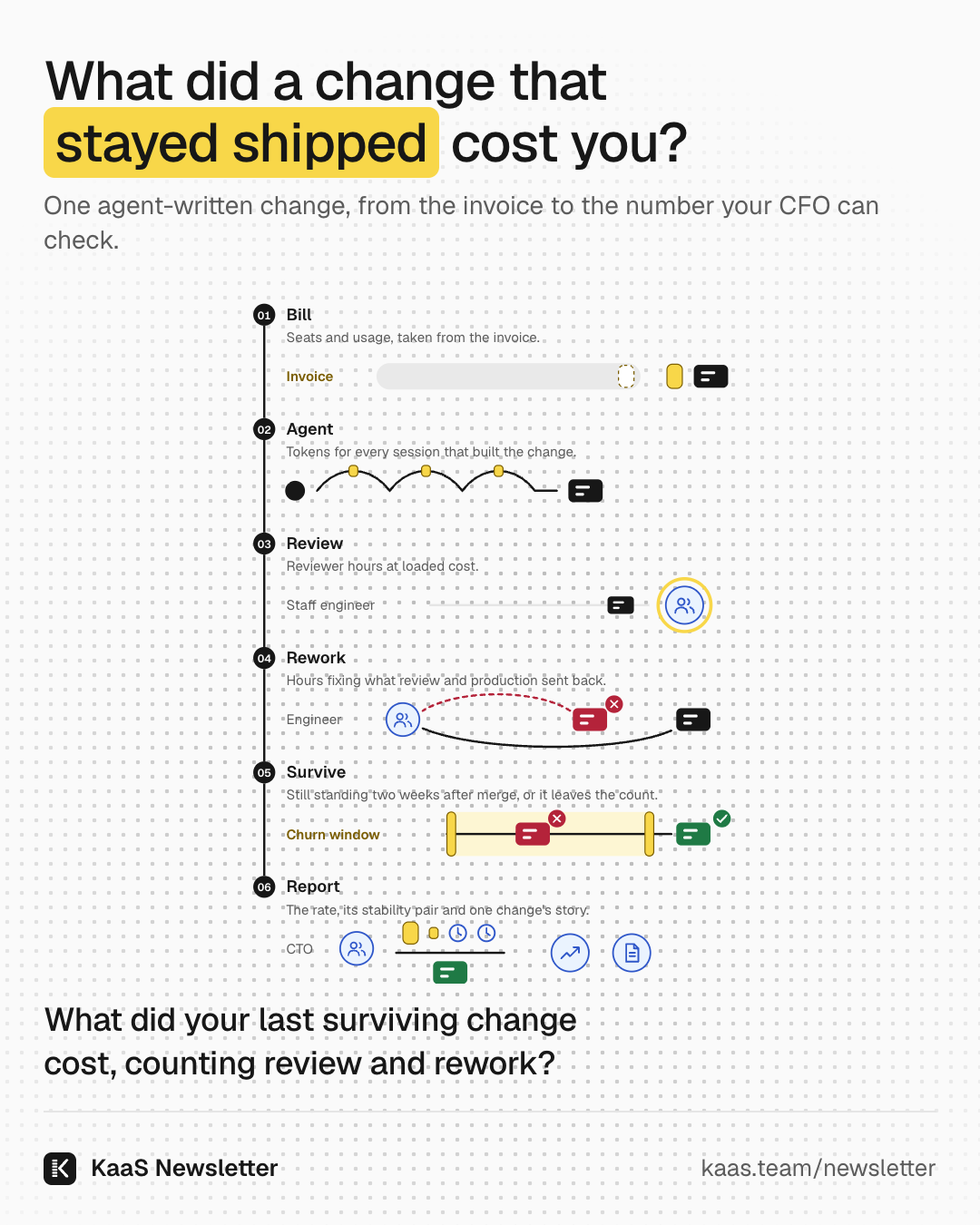
What did a change that stayed shipped cost you?
One agent-written change, from the invoice to the number your CFO can check.
What did your last surviving change cost, counting review and rework?
KaaS Newsletterkaas.team/newsletter
Your CFO asks what the AI line on the engineering budget buys. The honest answer, at most companies, is a seat count and a token graph.
That line is not standing still. In Jellyfish's usage data from March to August 2026, the typical company's AI spend per active user tripled in six months, and the vendor's own conclusion is that a flat seat line no longer matches the data1.
Cost per merged change is the AI ROI number worth taking to a CFO, but only if it counts the whole bill, review and rework included, and divides by changes that survived. To price one, we follow a single change at Acme Inc: an agent adds a rate limit to Acme's public API.
Seats and tokens count what you bought, and the bill no longer sits still
Seats and tokens measure what you bought, and since agents started running for hours, the bill they add up to no longer stays still. One vendor that publishes a cost-per-merged-PR definition says those count inputs, not what shipped2.
The bill is also getting harder to forecast. The largest code host has announced that every plan of its coding assistant moves to usage-based billing in June 20263. Its stated reason is that a quick question and a multi-hour agent session were billed the same3.
A bill that moves with usage gets noticed, and one commenter on Hacker News describes the moment the questions turn into a brake.
The other thing that's changing is more and more CFOs are looking at the AI spend in engineering departments and hitting the brakes. Token leaderboards were cool when the spend wasn't a double-digit-percent of the entire department's budget including salaries.
At Acme, the rate-limit change shows up on the invoice twice and nowhere useful.
- Seat linethe same every month, whatever the agents didInvoice gate
- Usage linegrew with every long agent session that built itInvoice gate
- Shipped?neither line says whether the change is still standingCTO
Spend per developer is uneven, so an average cost hides where it goes
AI spend lands unevenly across developers, so an average cost per change hides the heaviest users. Andrew Lau, Jellyfish's CEO, sums up his company's first-quarter 2026 data this way.
Developers in the top decile use nearly ten times more tokens for about two times the throughput.
- Tokens usedabout ten times
- PR throughputabout twice
The same data puts token cost per merged PR more than three hundred times higher at the top usage tier than at the bottom5. These are token costs only, from the vendor CEO's own write-up of its report in a trade outlet. Read the ratio as a shape: an average across the team hides a tail that costs many times more per change.
Consumption numbers also invite gaming, which is why a raw count makes a poor target.
It's really hard to know if somebody's gaming the system.
LeadDev quoted Narayan in a piece on teams that ranked engineers by token use. In the same piece, Ankit Jain, founder of The Hangar, says the failure was letting an onboarding metric be used for performance management6. The rule we draw: the number is a team figure, never a ranking of people.
At Acme, the rate-limit change took several long agent sessions; a one-line bug fix merged the same day took one prompt. Averaged together, they look the same price. Split by change, they tell the CFO where the money went.
Divide the whole bill, review and rework included, by changes that survived
The number needs a numerator that is the whole bill and a denominator that cannot be inflated. Opened PRs inflate it. In LinearB's 2026 benchmarks, even at the top 10% of organizations, 79% of agent-opened pull requests merged within 30 days, against 92% of human-only ones7. Divide spend by opened PRs and the agent looks cheaper than it is, because the ones that never merge still cost tokens and review.
One vendor's formula adds four terms: token spend, tool and seat spend, review time cost and rework cost, divided by PRs that merge and survive a churn window2. Survived means the change was not reverted or substantially rewritten inside that window2. The vendor's example window is two weeks, and we use the same length throughout this issue.
Review belongs in the cost because it is paid for. Review time climbs as AI adoption climbs, as our first issue showed8. None of it appears on the AI invoice.
- Seatthe change's share of the licence lineInvoice gate
- Agent runsusage tokens for every session that built itAgent
- Reviewreview hours at loaded costStaff engineer
- Reworkhours fixing what review and production foundEngineer
- Mergethe change landsTech lead
- Two weeksreverted or rewritten, it leaves the denominator; its cost stays inChurn window gate
The vendors do not agree on the definition, and a CFO should know that. A second vendor's numerator is total engineering cost, developer cost plus AI spend9, and its denominator is effective PRs: merged volume adjusted downward by the rework rate9. A third leaves seats out entirely and says its figure "isn't your invoice"10. It calls its unit costs "directional rather than exact"10.
The FinOps Foundation names the gap in the token-only view.
Token economics which only accounts for tokens is therefore a partial view.
We recommend keeping seats in, because the CFO reconciles to the bill. Put rework in the cost, because hours are what finance pays for. Then keep one definition, unchanged, every month. No source we found tested which definition a CFO accepts.
At Acme, the rate-limit change merges, then is substantially rewritten inside two weeks after it throttles a large customer's batch job. Its seat share, tokens, review and rework hours stay in the numerator, and it leaves the denominator. That is the change the CFO's number must not count as delivered.
A falling cost per change can hide falling stability, so report it with a pair
A rate that only divides can fall for the wrong reason: more changes merge and more of them break. DORA's 2025 report still finds a negative relationship between AI adoption and delivery stability12. Its 2024 and 2025 reports disagree on whether AI speeds delivery, and in both, stability suffers as adoption rises1312.
Nor can the team's sense of speed stand in for a measurement. In METR's randomized trial, experienced open-source developers took longer with AI tools, yet still believed AI had sped them up by 20%14.
longer to finish real issues when allowed AI tools
The trial was small and used early-2025 tools, so read it as a warning about self-report. Quality signals point the same way: Uplevel's 2024 observational study saw a 41% higher bug rate for developers given an AI coding assistant, with throughput flat15.
So pair the rate with change failure rate, and add review time if you track it; that pairing is our advice, and these studies did not test it. Suppose Acme counted the rate-limit change as merged. The month's rate would fall, and only change failure rate beside it would show the month went badly. The survival rule catches a rewrite inside two weeks; the pair catches what breaks after it.
Take it to the CFO as a monthly trend with its pair and one story
Bring the CFO one rate every month, with change failure rate beside it, review time if you track it, and one change told start to finish. The CFO's problem is control, as a senior engineering leader put it at a Toronto CTO dinner held under Chatham House rules.
The CFO has no control once they’ve signed the contract over what the actual investment is going to be.
A rate shows the CFO what the contract buys each month, and it can be checked against the bill. At the same dinner, a leader said larger organizations expect a return within 12 months16. That clock belongs to larger companies, but it tells you how soon the question will come.
Numbers alone will not carry it. Jellyfish's board-reporting template warns that even great metrics draw a "so what" without narrative context17. That template looks back over the prior quarter; we suggest monthly because usage billing moves monthly.
- The ratethe month's whole bill over changes that survived, checked against the invoicesCTO
- The pairchange failure rate beside it, review time if trackedCTO
- The storythe rate-limit change, from the first agent session to the rewriteCTO
Finance buys changes that stay shipped
A unit cost only means something when the unit is what the business pays for. Finance does not buy tokens or seats; it buys changes that reach customers and stay there.
AI moved the cost of a change in two ways at once. It added review time that never reaches the AI invoice, and it moved the invoice from a fixed seat line to a variable usage line. In our view, a rate is how a CFO can judge a variable bill, and the rate is honest only if work that gets undone cannot inflate it.
The FinOps Foundation asks the same question one level up: the cost per outcome11. We think a merged change that survived is the closest outcome engineering can count without guessing at revenue. Acme paid for the rate-limit change the same way it paid for the changes that stayed; only the second kind is what finance bought.
What to do on Monday
- Reconcile to the bills. Total last quarter's AI spend, seats and usage, from the invoices themselves, since a dashboard estimate leaves lines out.
- Add the hours. Put review and rework hours in the cost at loaded rates; sample a month if you do not track time.
- Count what survived. Count changes merged last quarter that were not reverted or substantially rewritten within two weeks.
- Look at the spread. Split the result by team and usage tier before you average it, and never rank people by it.
- Report the pair. Send it monthly with change failure rate beside it, review time if you track it, and one change told start to finish.
The companion, The AI ROI playbook, is free with your work email.
What did your last surviving change cost, counting review and rework?
Param
Sources
- Jellyfish, Tokenomics for Your 2027 R&D Budget, 2026
- Unblocked, Cost per Merged PR: The Unit Economics of AI Coding, 2026
- GitHub Blog, GitHub Copilot is moving to usage-based billing, 2026
- Hacker News comment, 2026
- Jellyfish, AI Engineering Trends Report, via DEVOPSdigest, 2026
- LeadDev (Chantal Kapani), The tokenmaxxing hype didn't last long, 2026
- LinearB, The AI engineering productivity gap: 2026 benchmarks, 2026
- Faros AI, The AI Productivity Paradox research report, 2025
- LinearB Help Docs, AI ROI Dashboard, 2026
- Swarmia Help Center, AI impact ROI, 2026
- FinOps Foundation, Token Economics: The Atomic Unit of AI Value, 2026
- Google Cloud, Announcing the 2025 DORA Report, 2025
- Google Cloud blog, Announcing the 2024 DORA report, 2024
- METR, Measuring the Impact of Early-2025 AI on Experienced Open-Source Developer Productivity, 2025
- Uplevel Data Labs, Can GenAI Actually Improve Developer Productivity? (PDF mirrored by Simon Willison), 2024
- ShiftMag, CTOs agree cognitive debt is the new technical debt, 2026
- Jellyfish, Bringing AI to the Boardroom: 6 Slides for Engineering Leaders, 2025