A free playbook, as a PDF and an EPUB
The AI ROI playbook
Baseline, full cost, a fair comparison and payback, followed on one platform team to the number finance signs. For CTOs and VPs of Engineering.
The playbook is open in a new tab
If it did not open, open the PDF. For a reading app, download the EPUB. Both links work for ten minutes; the form gives you fresh ones any time.
Want the six files written for your own repo?
In a 30-minute call we look at one of your repos together and find the gate where your changes wait longest.
Look inside2 of the 60 pages, as they print.
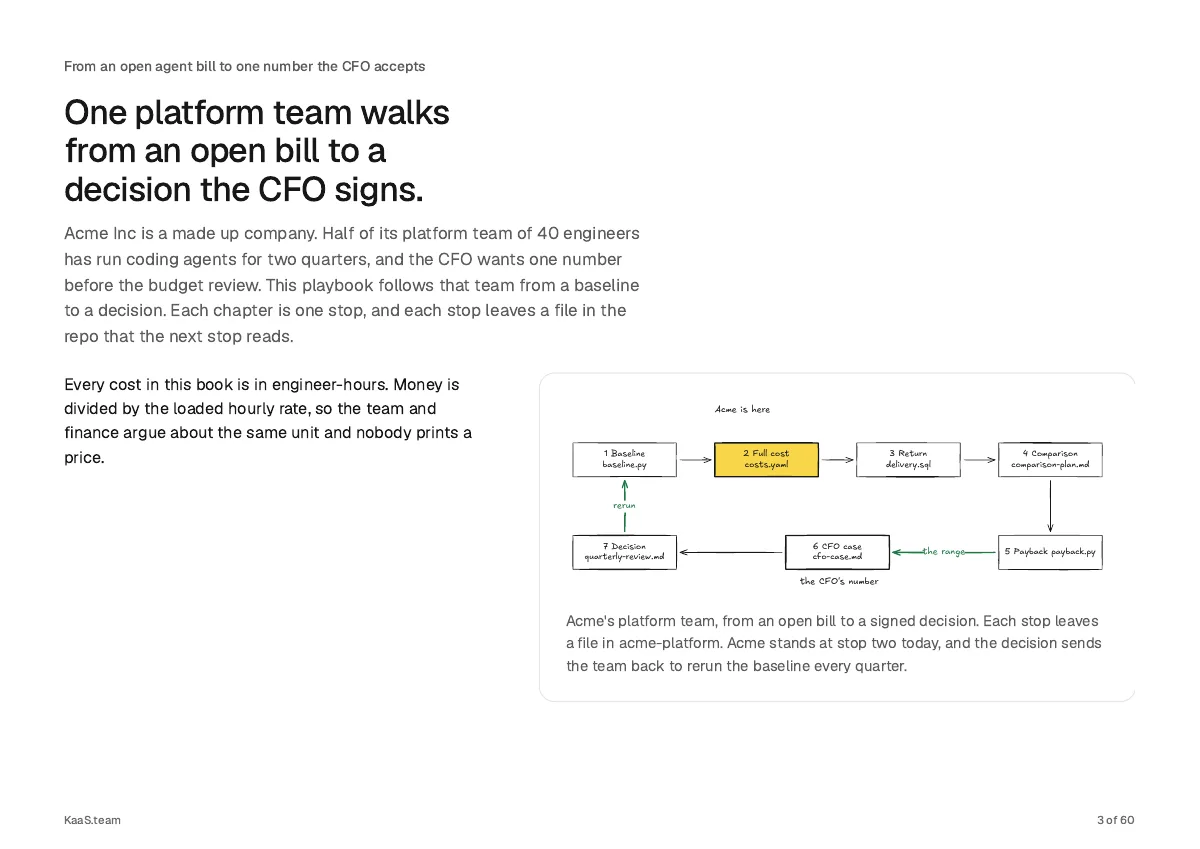
Page 3: One platform team walks from an open bill to a decision the CFO signs. 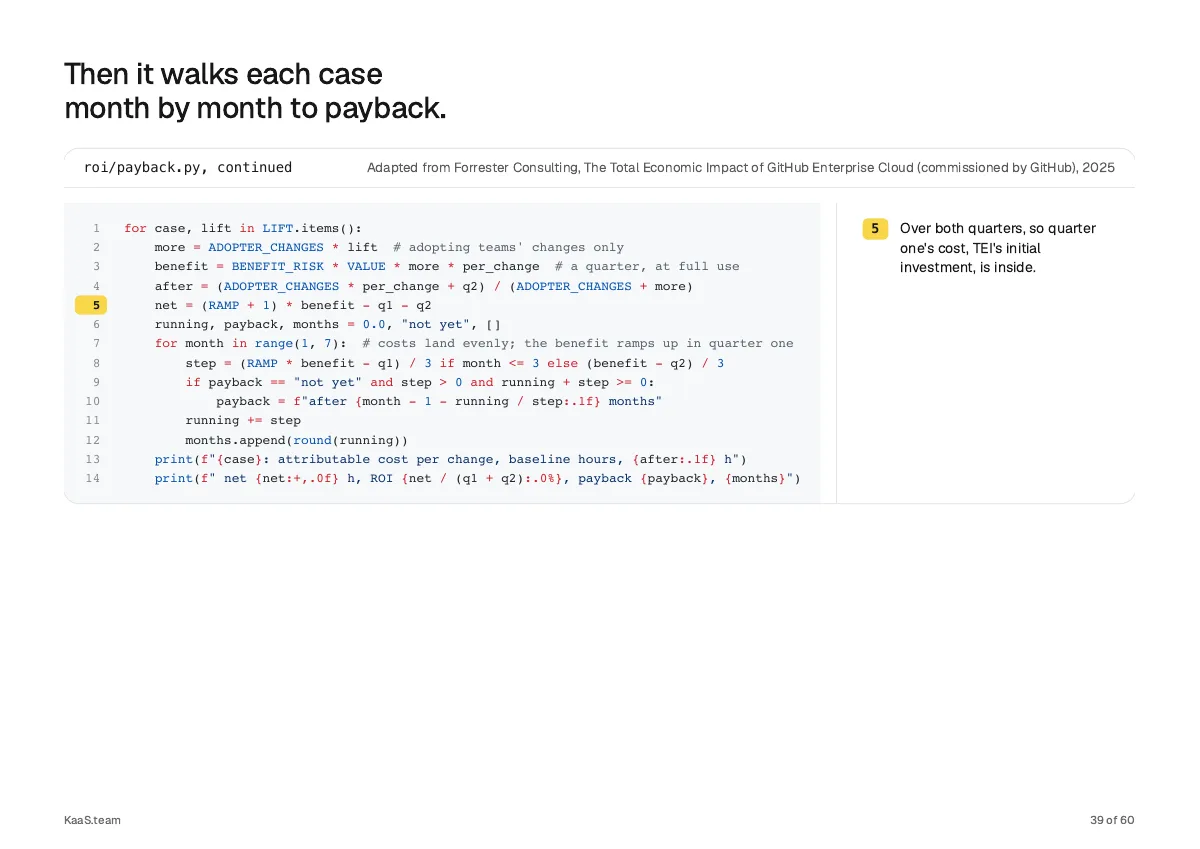
Page 39: Then it walks each case month by month to payback.
What the playbook covers
From an open agent bill to one number the CFO accepts. Acme Inc is a made up company. Half of its platform team of 40 engineers has run coding agents for two quarters, and the CFO wants one number before the budget review. This playbook follows that team from a baseline to a decision. Each chapter is one stop, and each stop leaves a file in the repo that the next stop reads.
Why the obvious AI ROI number does not survive finance. The CFO asked Acme for one number. Here is why the numbers on Acme's dashboards will not do: seat counts, acceptance rates and how fast people feel all point up, and none is a number finance can sign. The chapter sets the bar every later number has to clear: delivered work, a baseline and a fair comparison.
Set the baseline from the last quarter before agents. Acme stands at stop two with a bill. Before the cost can mean anything, the team walks back to stop one and rebuilds the last quarter before agents from data that already exists: engineering hours, merged changes and the delivery metrics.
Count the full cost, not just the seats. The bill finance sees is seats and usage. Acme's real cost also moved hours into review, rework, incidents and training. This chapter writes every line down with its source and keeps it in engineer-hours. Money lines convert at the loaded hourly rate, so the ledger never prints a price. Only the lines that add to the total reach the payback.
Measure the return in delivered changes, not lines or seats. Acme's dashboards show accepted suggestions and lines added. Finance needs changes that reached production, how fast and how often they broke. This chapter picks the measures and writes the query.
Attribute the change with a fair comparison. Acme's adopting teams delivered a quarter more changes, but Acme also hired and the season changed. This chapter separates the agents' share from everything else, with a design a team without researchers can run.
Compute cost per merged change and the payback period. Acme now has a baseline, a ledger, a return and an attributable lift of 17 percentage points (5 to 29). This chapter turns them into the CFO's number: cost per merged change before and after, ROI and payback, as a range.
Write the one-page CFO case. The CFO gets one page two days before the review: the number, the range, what it cost, what was not counted, the assumptions and the risks. This chapter writes that page and the answers to the pushback. The finance partner traces every number on it to a file and its owner before it is sent. The pushback answers cover the usage bill, self-reported time saved, merge counts, vendor studies and a spending cap.
Decide to expand, hold or cut, and hand over the quarterly review. The CFO signs "expand by one cohort". From here a named owner reruns the numbers each quarter and the decision is made again against the baseline. This chapter writes the decision rule, the quarterly review file and the handover to that owner.
Find out where your engineering system stands. The book measures what agents are worth on one team. When the low case does not pay back, or gains vanish at company level, the return may be held back by the delivery system: review, release, context or ownership. It may also be the tool's cost, a small lift or noise. The assessment shows where your system stands. It takes two minutes and places your team at one of four stages, from experimenting to AI-native, and a call or an enquiry can follow from there.