A free playbook, as a PDF and an EPUB
The AI code review playbook
Unblock review when agents write the pull requests: one agent PR followed from a baseline to the handover. For CTOs and VPs of Engineering.
The playbook is open in a new tab
If it did not open, open the PDF. For a reading app, download the EPUB. Both links work for ten minutes; the form gives you fresh ones any time.
Want the six files written for your own repo?
In a 30-minute call we look at one of your repos together and find the gate where your changes wait longest.
Look inside2 of the 74 pages, as they print.
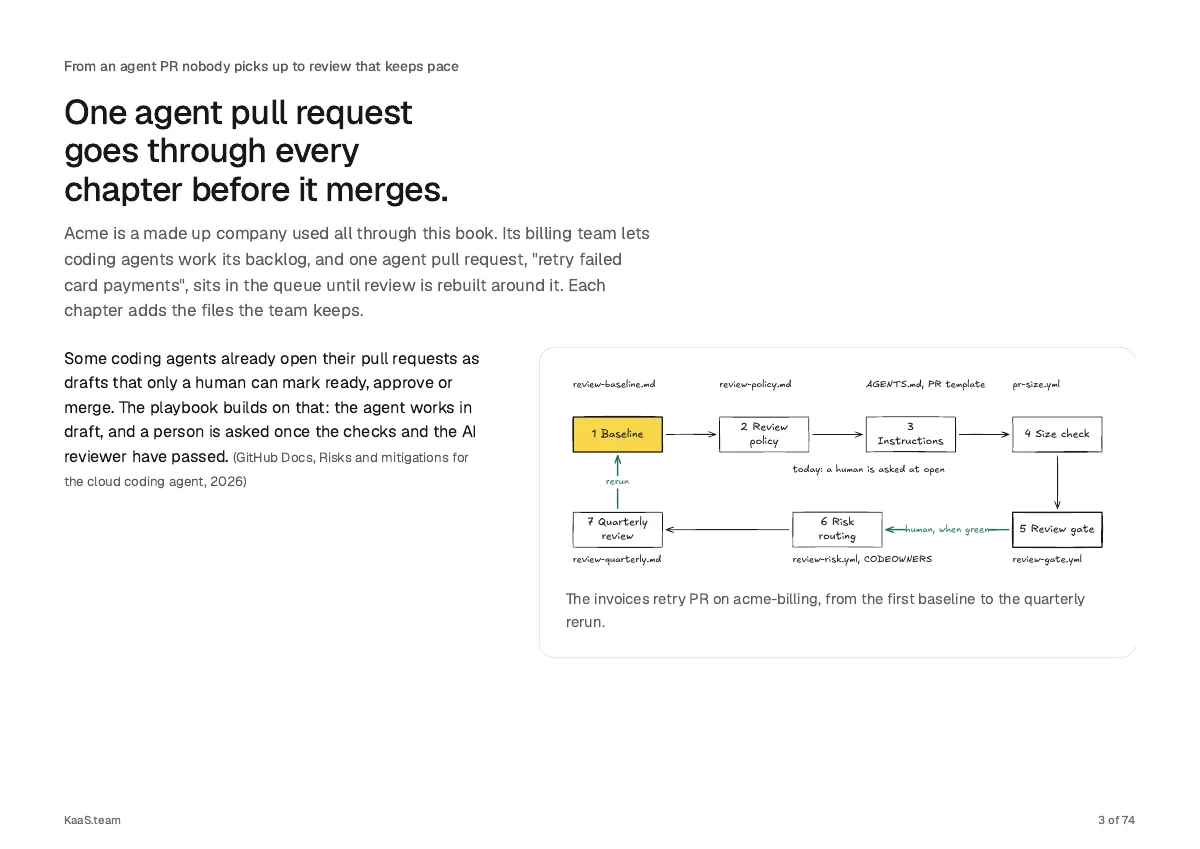
Page 3: One agent pull request goes through every chapter before it merges. 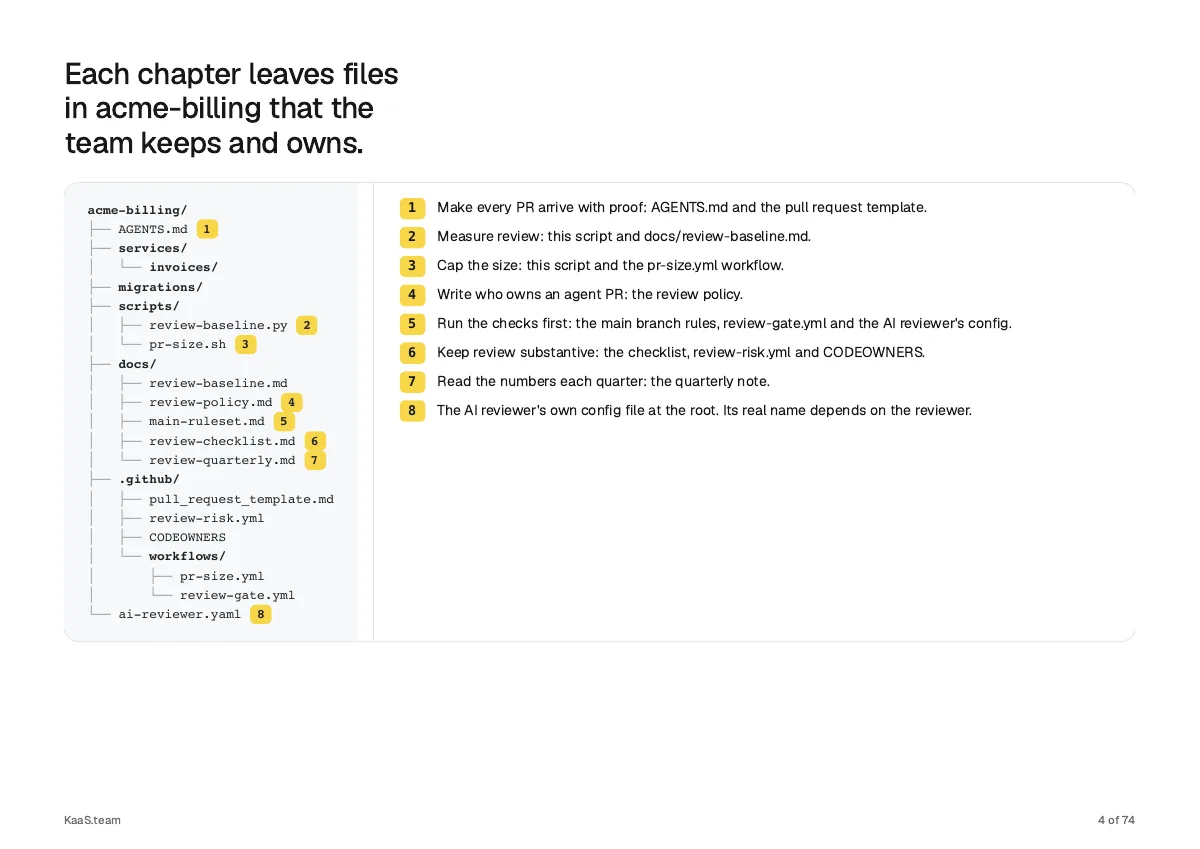
Page 4: Each chapter leaves files in acme-billing that the team keeps and owns.
What the playbook covers
From an agent PR nobody picks up to review that keeps pace. Acme is a made up company used all through this book. Its billing team lets coding agents work its backlog, and one agent pull request, "retry failed card payments", sits in the queue until review is rebuilt around it. Each chapter adds the files the team keeps.
Measure review before you change it. The invoices retry PR waits, but nobody can say where. A script reads a quarter of PR events and records, per type of PR, how long it waits for a reviewer, how long it spends in review, how often it goes back for changes, how often it is reverted, and how often a human writes a real comment.
Write who owns an agent PR and what a bot may approve. An agent opened the invoices retry PR and a bot approved it, so nobody can say who answers for it. This chapter writes the review policy: the engineer who started the run owns every line, an AI review never stands in for a code owner, and nobody bypasses the main branch rules, admins included. The team agrees it in one meeting. A pull request that breaks it gets a label and a reply to paste, not a debate. Each approval rule says which reviewer setup it holds for, so anyone can check it.
Make every agent PR arrive with intent, proof and a repro. With the policy on main, the invoices retry PR comes back for review with a long body and no proof that a retry works. This chapter writes the instructions the agent reads and the template every PR fills, so the author proves the change before a reviewer looks.
Cap the size of an agent PR and split the ones that break it. With the template on main, the invoices retry PR came back with proof, and with the retry logic, a migration, config and tests in one diff. This chapter writes the size check and the play that splits a PR into a stack of review units. Each unit is reviewed on its own, and the agent is asked once to split, not argued with. Most splits fail in the same few ways, and the chapter names them.
Run the checks and the AI reviewer before any human. A code owner is asked about the migration slice while its checks run. This chapter asks a human only once the draft is green.
Keep human review substantive as volume rises. The retry slice is green, and green agent PRs reach the billing owners faster every week. This chapter routes each to its owner, with a checklist and a weekly rota, so a green PR still gets a real read and no reviewer faces the whole queue alone.
Read the numbers each quarter and hand every file an owner. A quarter later the invoices retry PR has merged, with its stack and the agent PRs that followed it. This chapter reruns the baseline with the same query, writes the quarterly note that names one change for the next quarter, and names who keeps each file, so review keeps pace after the people who built it move on. Review comments worth keeping move into AGENTS.md, so the agent stops repeating them.
Find out where your team's review stands. The invoices retry PR merged, its stack is closed, and review at Acme keeps pace in one repo, each file on main with an owner. The quarterly read points past review, to delivery, ownership and how the team works with agents. The assessment asks where your team stands on each, from experimenting to AI native, and shows which to fix next.